
Last updated October 30, 2026
 Wrought iron
 Wood & steel frame
 Farm & ranch
 Sliding driveway gates
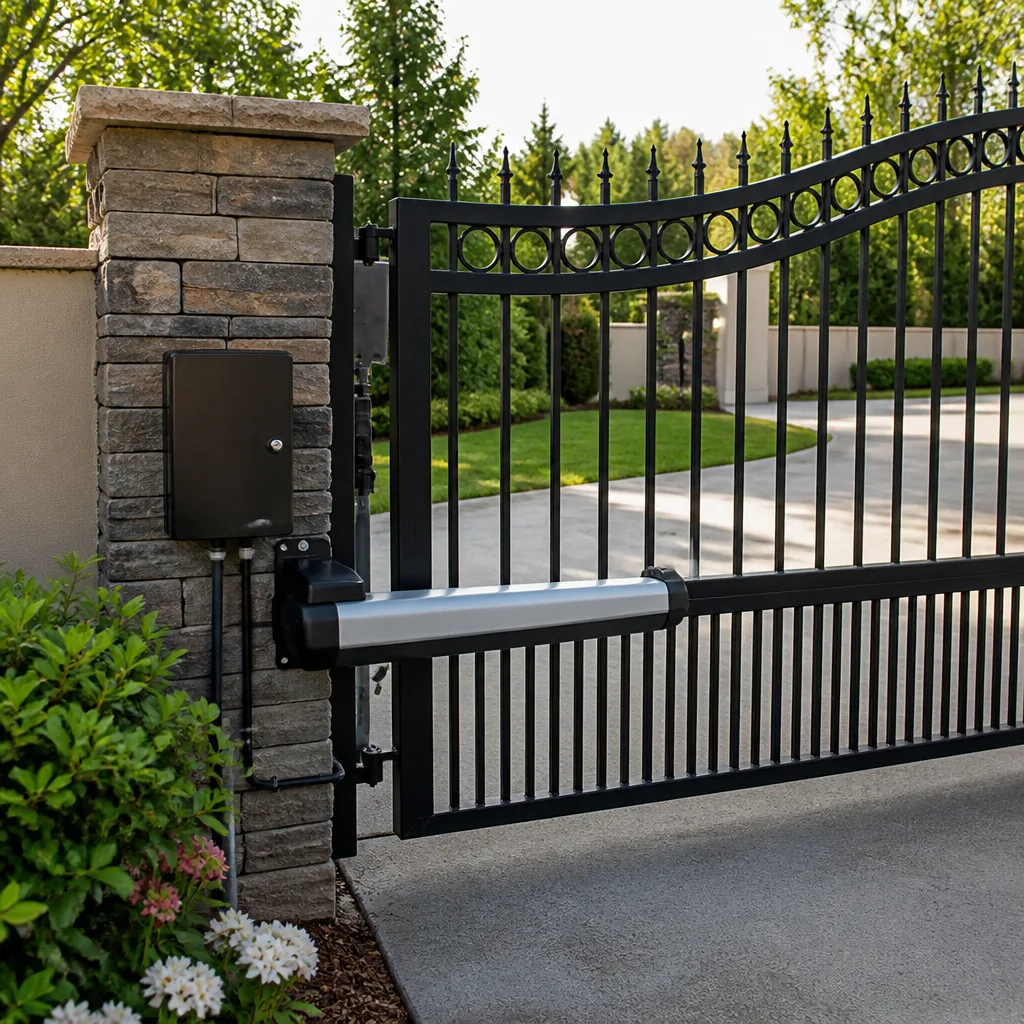 LiftMaster operators
Free on-site gate assessment - hinges, posts, and your LiftMaster or Nice gate operator checked before anything is quoted
The assessment is free and the quote is the invoice.
Get your free estimateGate Repair Warning Signs: A DeSoto Homeowner’s Reference Guide
A gate that hesitates for two seconds before moving isn’t “slow.” It’s a gate whose operator is drawing excess current to overcome mechanical resistance, which means a drive component is failing and the motor is next. Most DeSoto homeowners don’t discover a gate problem until the gate stops working entirely. That’s the expensive way to find out. This guide maps specific symptoms to specific failing components so you can hear the difference between a Gate Repair services call and a $1,400 replacement before it happens. We’ve written this specifically for DeSoto conditions: clay soil that moves posts, summer heat that cooks circuit boards, and spring storms that expose wiring failures. By the end, you’ll know what to watch, what to listen for, and when to pick up the phone.
Quick Answer
Gate repair warning signs in DeSoto fall into five categories: grinding or scraping noises (mechanical wear), hesitation or slow operation (motor strain), reversing before full close (sensor or obstruction issues), partial travel (limit switch or logic board failure), and total non-response (power or control board failure). Most of these announce themselves weeks or months before a complete breakdown. A homeowner who catches them early typically pays $200 – $500 for component repair versus $1,200 – $2,500 for a full operator replacement.
Styles & brands we work with
Table of Contents
- What Your Gate’s Noises Are Telling You
- Hesitation and Slow Operation: The Motor’s Distress Signal
- When Your Gate Reverses Without Reason
- Partial Travel: Why Your Gate Stops Halfway
- Total Non-Response: Power, Boards, and Dead Ends
- DeSoto-Specific Warning Signs: Clay, Heat, and Storms
- The Repair Priority Framework: Now, This Month, or Monitor
What Your Gate’s Noises Are Telling You
A healthy automatic gate makes a consistent hum during operation. When that hum changes pitch, gains a metallic edge, or becomes intermittent, a specific component is failing. Grinding, scraping, clicking, and squealing each indicate a different problem at a different price point. We’ve diagnosed hundreds of gates in DeSoto by sound alone before we ever opened a panel.
Grinding or Metallic Scraping
Grinding almost always means metal-on-metal contact where there shouldn’t be any. Most commonly this is a failing wheel or roller assembly on a sliding gate, or a hinge pin that’s lost lubrication on a swing gate. On LiftMaster operators, it can also indicate a stripped drive gear. The repair is cheap if caught early: a replacement wheel costs under $80. Ignored for months, the damaged wheel scores the track, and now you’re replacing track sections at $400 – $800.
Clicking That Repeats Without Movement
A rapid clicking sound with no gate movement typically means the operator’s capacitor or start relay is failing. The control board is sending the start signal, but the motor can’t begin its rotation. This is an electrical problem, not a mechanical one. In our experience with DoorKing and Linear operators, this symptom is misdiagnosed as a battery issue constantly. It’s not the battery. It’s the starting circuit, and continuing to hit the remote accelerates the damage.
Squealing During the First Few Feet of Travel
A squeal that fades after the gate gets moving usually points to a dry or failing drive pulley or chain tensioner. On Ghost Controls residential openers, this is the single most common noise complaint we hear in DeSoto. The fix is often a tension adjustment and lubrication, but if the bearing inside the pulley has failed, lubricant won’t help. A pulley replacement runs $150 – $300 including labor.
What Noise Is Actually Normal?
A low, steady hum. A soft click when the gate reaches its fully open or closed position. Occasional creaking that responds to temperature changes. Anything rhythmic, irregular, or metal-sounding is the gate telling you something specific. The fix is always cheaper the day you first hear it.
Hesitation and Slow Operation: The Motor’s Distress Signal
When you press the remote and the gate pauses for a noticeable beat before moving, or when a gate that used to travel in 15 seconds now takes 25, your operator is working harder than it was designed to. Motors draw more current when they meet resistance. That excess current generates heat. Heat degrades motor windings, capacitors, and control board solder joints. Every slow cycle is actively shortening the life of your operator.
The Mechanical Cause: Resistance
Sliding gates in DeSoto accumulate fine clay dust in their track and rollers. This dust acts as an abrasive and a friction source. A gate that’s slow in dry weather but moves normally after a rain is telling you the track is dirty and the rollers are binding. The fix is a thorough track cleaning and roller inspection. Skipping this and forcing the gate to operate anyway is how a $100 maintenance visit becomes a $700 motor replacement.
The Electrical Cause: Capacitor Degradation
Capacitors provide the initial voltage spike that starts the motor. They degrade with age and heat exposure. A failing capacitor delivers less starting torque, which produces exactly this hesitation. In DeSoto summers where ambient temperatures exceed 100 degrees, capacitors fail faster than in cooler climates. If your gate hesitates only after sitting in direct afternoon sun, suspect the capacitor before anything else. Replacement cost: $60 – $120.
The Temperature Test
Here’s a diagnostic you can run at home: operate the gate early in the morning before the sun hits the operator housing. Then operate it again at 3:00 PM on a hot day. If it’s slower in the heat, the problem is electrical, likely a failing capacitor or an overheating control board. If it’s slow in both conditions, the problem is mechanical resistance in the track or drive assembly. This distinction tells a technician exactly where to start looking, and it saves you money on diagnostic time.
When Your Gate Reverses Without Reason
An automatic gate that closes halfway and then reverses is doing what it was designed to do: responding to an obstruction signal. The question is whether there’s actually an obstruction or whether a sensor is sending a false signal. Security gates with built-in safety edges and photocell sensors are programmed to reverse on any interruption. When the safety equipment itself fails, it creates phantom obstructions.
Photocell Misalignment or Dirt
The most common cause of phantom reversing is a misaligned photocell. These are the small sensors mounted near ground level on either side of the gate opening. If one has been bumped, shifted by post movement, or covered in dust and grass clippings, it interrupts the beam intermittently. Clean the lenses first. If the problem persists, the sensor alignment has drifted and needs recalibration. On FAAC and Viking systems, this is a 20-minute fix.
Safety Edge Failure
The rubber safety edge on the leading edge of the gate contains a pressure-sensitive strip. When water intrudes through a crack in the rubber, the strip corrodes and begins sending false contact signals. This is extremely common in DeSoto after spring storms. The gate reverses because its safety system thinks it’s hitting something. A replacement safety edge runs $80 – $150 in parts and takes under an hour to install.
Post Movement in Clay Soil
DeSoto sits on expansive clay soil that shrinks in drought and swells after rain. Gate posts set in this soil move measurably over time. A post that’s shifted even half an inch can throw off photocell alignment, bind the gate’s travel path, and trigger safety reversals. If your gate reverses at the same spot every time, check whether the post has leaned. The gate is hitting a physical obstruction you can see, and the post movement is why it appeared. This ranks among the most common structural issues we see across DeSoto neighborhoods, and it doesn’t fix itself.
Partial Travel: Why Your Gate Stops Halfway
A gate that opens a few feet and stops, or closes most of the way and stops, has lost its position reference. Automatic gates don’t inherently know where “open” and “closed” are. They rely on limit switches or logic board settings that define those positions. When those settings are lost or a limit switch fails, the gate stops wherever it happens to be when the signal cuts out.
Failed Limit Switch
Mechanical limit switches physically trip when the gate reaches its open or closed position. They’re mounted inside the operator housing and are exposed to every weather cycle. A failed limit switch means the operator never receives the “stop” signal at the correct point, so it stops early. On DoorKing slide operators, limit switch failure is one of the most frequent repairs we perform in DeSoto. The switch itself is inexpensive; the labor to access and replace it usually brings the total to $150 – $250.
Logic Board Memory Loss
Modern operators store travel limits digitally on the control board. Power surges, lightning strikes, and capacitor failures can reset the board and erase those limits. After a thunderstorm, if your gate suddenly stops partway through its cycle, the board probably lost its programming. Reprogramming limits is a standard service call, but repeated memory loss indicates the board needs replacement. A board that can’t hold its settings is a board that’s failing.
Stripped Drive Components
On chain-driven or belt-driven operators, partial travel can indicate a stripped gear or a worn belt that’s slipping. The motor runs, but the drive system can’t transfer full power to the gate. You’ll usually hear a grinding or skipping noise along with the partial travel. This is a component failure that will complete itself, meaning the gate will eventually stop moving entirely, and it’s cheaper to address before the stripped gear damages adjacent components.
Total Non-Response: Power, Boards, and Dead Ends
A gate that doesn’t respond at all, whether from the remote, keypad, or manual switch, presents a diagnostic fork: either the operator has no power or the control system isn’t processing signals. The distinction matters because one is a simple electrical fix and the other is a component replacement. Neither is a mystery to a qualified technician, but the homeowner’s first move is to identify which category they’re in.
Power Supply Checks You Can Do Safely
- Check the breaker. Gate operators are usually on a dedicated circuit. A tripped breaker suggests a short or surge, not just an overload.
- Check the operator’s power switch. Most operators have a clearly marked on/off switch on the unit itself. It gets bumped more often than you’d think.
- Check for visible damage to the wiring. In DeSoto, UV exposure cracks wire insulation over time. If you can see bare copper or cracked conduit running to the operator, that’s likely your culprit.
- Listen for any sound. A faint hum or click from the operator when you press the remote means it has power and the problem is downstream: the board, a limit switch, or the motor itself.
When the Board Is Dead
If the operator has verified power but produces zero response, the control board is the primary suspect. Boards fail from moisture intrusion, insect activity, power surges, and plain age. On Linear operators, we commonly find ant colonies inside the control housing. Ants create a conductive path across the board and short it out. It sounds small, but it kills boards effectively. A board replacement on a residential operator runs $250 – $500 installed depending on the model.
The Value of Brand-Agnostic Diagnosis
This is where working with a shop that actually diagnoses matters. A technician who defaults to “whole operator needs replacing” when the board is dead is selling you a $1,800 job for a $300 fix. We troubleshoot across LiftMaster, FAAC, BFT, Linear, Viking, Ghost Controls, DoorKing, Elite, and Mighty Mule because the failure patterns are brand-specific. Knowing which boards fail in which ways, and which components typically take them out, is what lets us repair rather than replace.
DeSoto-Specific Warning Signs: Clay, Heat, and Storms
DeSoto’s climate and soil create failure patterns that a generic gate repair guide won’t mention. These aren’t theoretical. They’re the patterns we see when we drive across DeSoto responding to service calls.
Post Lean from Clay Soil Movement
Expansive clay soil is the defining geological feature of DeSoto and much of North Texas. It shrinks during August droughts and swells after October rains. Gate posts, even properly concreted ones, shift with this cycle. Warning signs of post movement include a gate that scrapes the ground at one end of its travel, a latch that no longer aligns, and a widening gap at the top of the gate when closed. Catching post lean early means a post re-set and concrete work for $400 – $800. Letting it progress means the gate itself bends or the operator mounts crack, pushing the repair into the thousands.
Rust Patterns That Reveal Water Intrusion
North Texas doesn’t have coastal salt air, so most rust on DeSoto gates comes from one source: water getting where it shouldn’t be. Look for rust streaks running down from hinge points, weep holes, and the bottom rail of the gate. This indicates water is pooling inside the gate frame or sitting against hardware. The fix is drilling proper drainage and treating the corrosion before it compromises structural welds. A gate that rusts from the inside fails from the inside.
UV-Cracked Wiring Conduit
The DeSoto sun is brutal on plastic. Flexible conduit running from the operator to the gate or to photocell sensors cracks after 5 – 7 years of direct exposure. Cracked conduit lets water and insects into the wiring path. The first warning sign is usually intermittent sensor faults or a gate that works only in dry weather. Replacing UV-damaged conduit is a minor repair that prevents major electrical failures.
The Repair Priority Framework: Now, This Month, or Monitor
Not every warning sign demands immediate action. But treating a “now” problem as a “monitor” problem is how small repairs become operator replacements. Here’s a framework you can apply today.
Repair Now
- Gate reverses and won’t fully close: You have no perimeter security until this is fixed. This is the entire point of having a gate.
- Grinding or metal-on-metal sounds: Active component damage. Every cycle makes it worse.
- Gate stops mid-travel and won’t complete a cycle: The gate is a security gap and a liability risk in this position.
- Any electrical burning smell from the operator: Stop using the gate. This is a potential fire hazard and the board or motor is actively failing.
Schedule Within 30 Days
- Consistent hesitation when starting: The capacitor or drive system is degrading. Not an emergency, but don’t wait for it to become one.
- Squealing that’s present every cycle: A dry or failing pulley. It will seize eventually.
- Post lean that’s visible but not yet affecting operation: The clay soil is working on it. The gate still works, but the structural problem compounds with each weather cycle.
- Intermittent sensor faults: The gate works, but the safety or obstruction sensors are sending false signals occasionally.
Monitor
- Slow operation in extreme heat only: An early sign of capacitor wear, but not urgent. Track whether it worsens.
- Minor creaking that responds to temperature changes: Normal metal expansion. Lubricate at your next maintenance visit.
- Surface rust starting on hardware: Treatable with cleaning and protection. Don’t let it reach structural components.
Why “Mostly Works” Is a Trap
Here’s the counterintuitive part: a gate that’s fully stopped isn’t accruing damage. It’s just sitting there. A gate that “mostly works” is still completing cycles while a component fails. That failing component is putting strain on every component connected to it. The motor strains against the worn drive. The drive strains against the binding track. The board works harder to manage the motor’s erratic draw. A partially working gate is a gate that’s actively accelerating its own decline, and the repair bill grows with each cycle you ignore.
Common Mistakes to Avoid
- Lubricating without diagnosing. If the noise is a failing bearing, lubricant masks the symptom for a week and the bearing fails anyway. Identify the source of the noise before applying anything.
- Adjusting limits without checking the mechanical cause. If post movement shifted the travel path, reprogramming the limits is a temporary patch. The post will keep moving.
- Replacing the remote batteries first. A non-responsive gate is rarely a dead remote. If the keypad and manual switch also do nothing, batteries were never the issue.
- Ignoring heat-related slowdowns as “normal.” A gate that struggles in the DeSoto summer is warning you about electrical component failure. It won’t improve in October; it will just hide the problem until the components finish degrading.
- Forcing a gate that won’t move. Holding the button down or repeatedly cycling the remote on a stalled gate burns out the motor. When it doesn’t move on the first command, stop.
- Skipping the safety edge inspection. A torn or waterlogged safety edge is a genuine safety hazard. This isn’t just about false reversing; it’s about the gate failing to reverse when a person or vehicle is in its path.
- Treating all operators as interchangeable. A LiftMaster slide operator and a Viking swing operator have entirely different failure modes. Replacements and repairs need to be brand-specific.
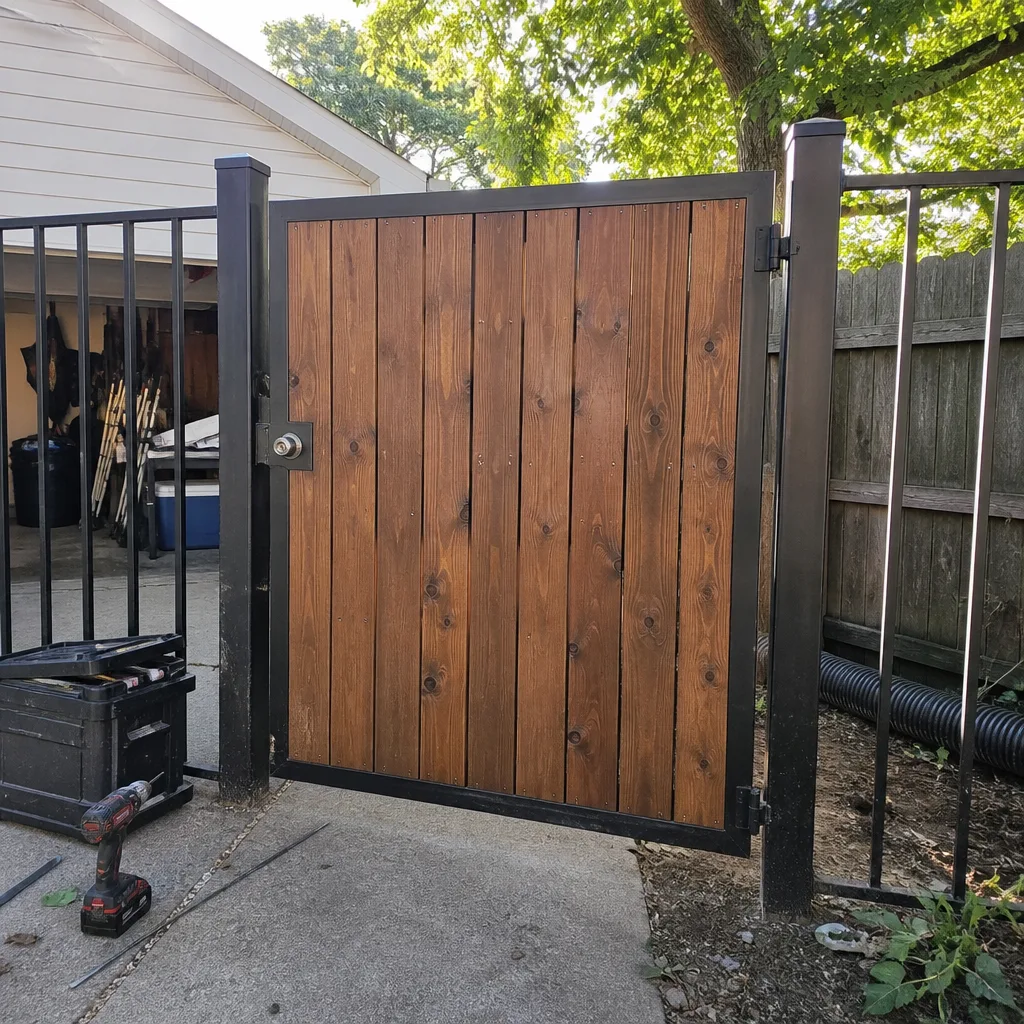
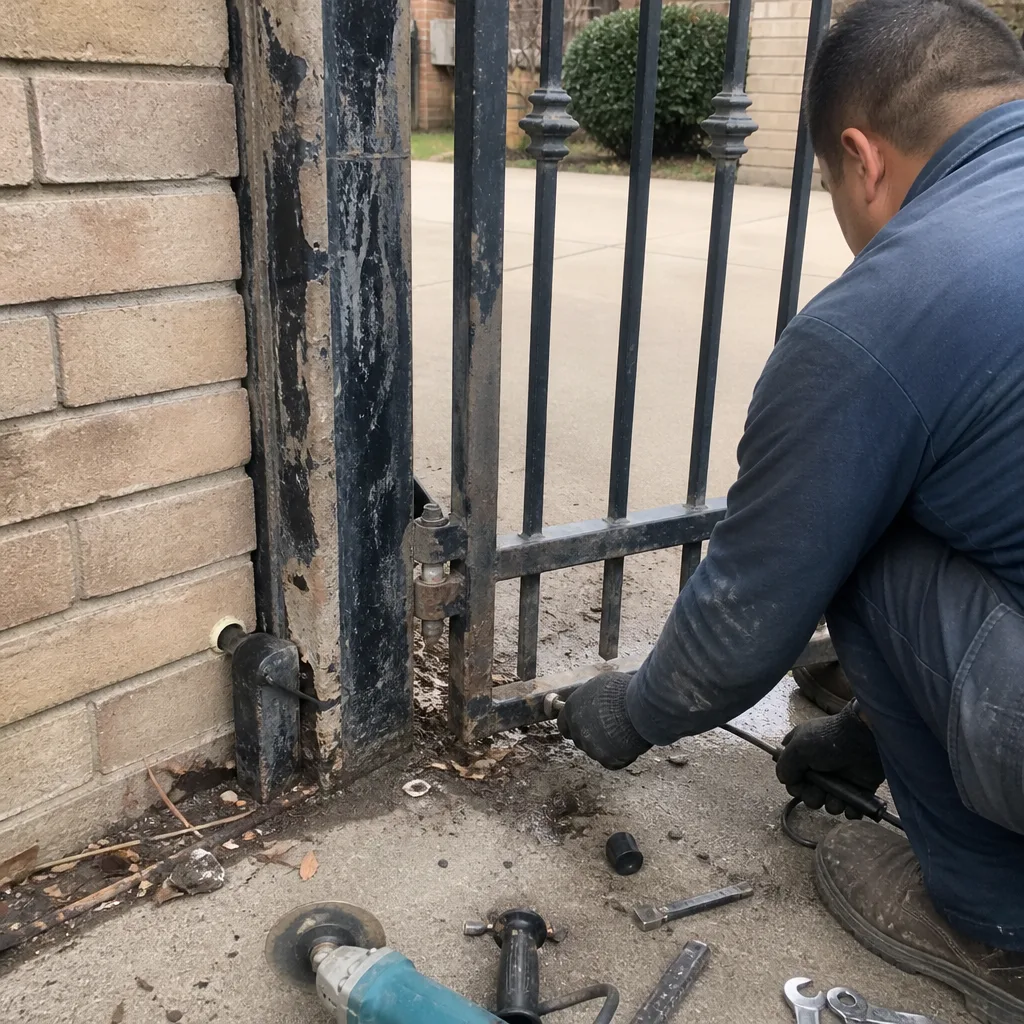
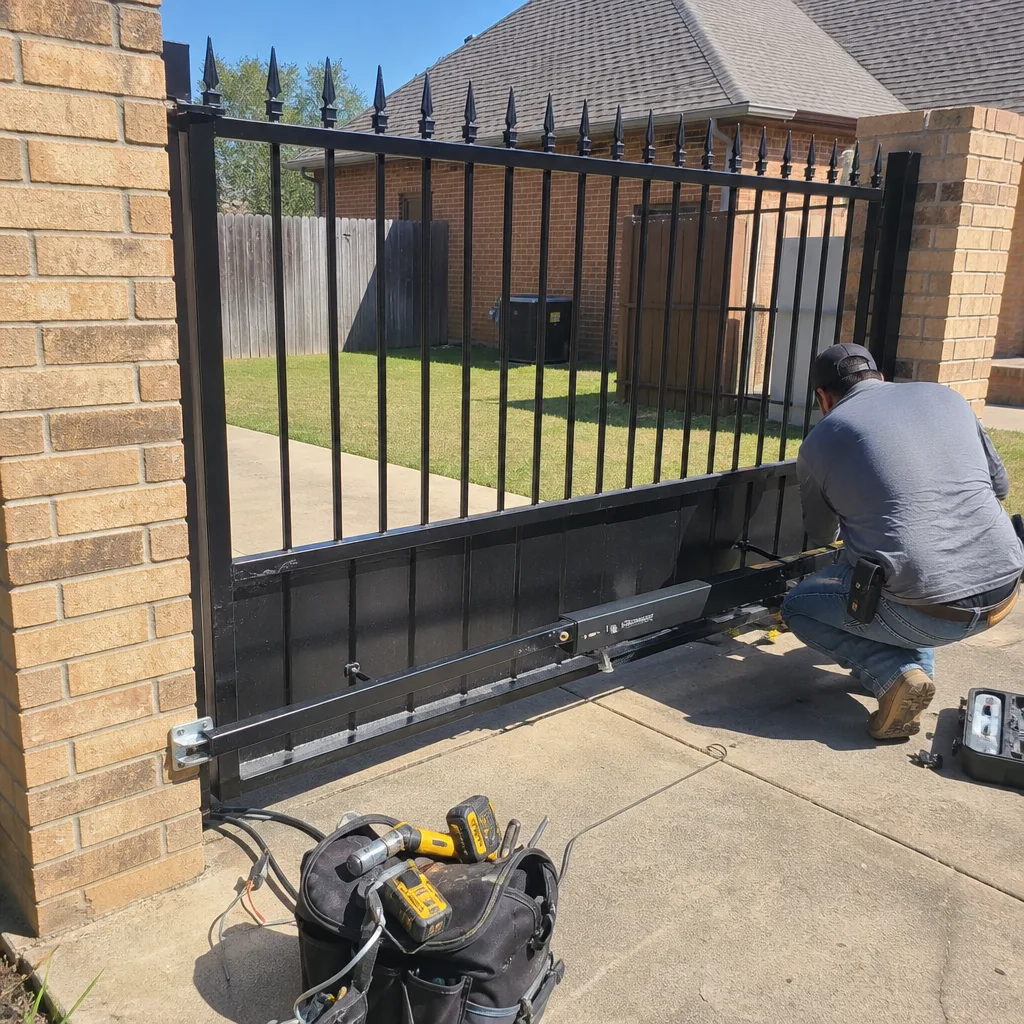
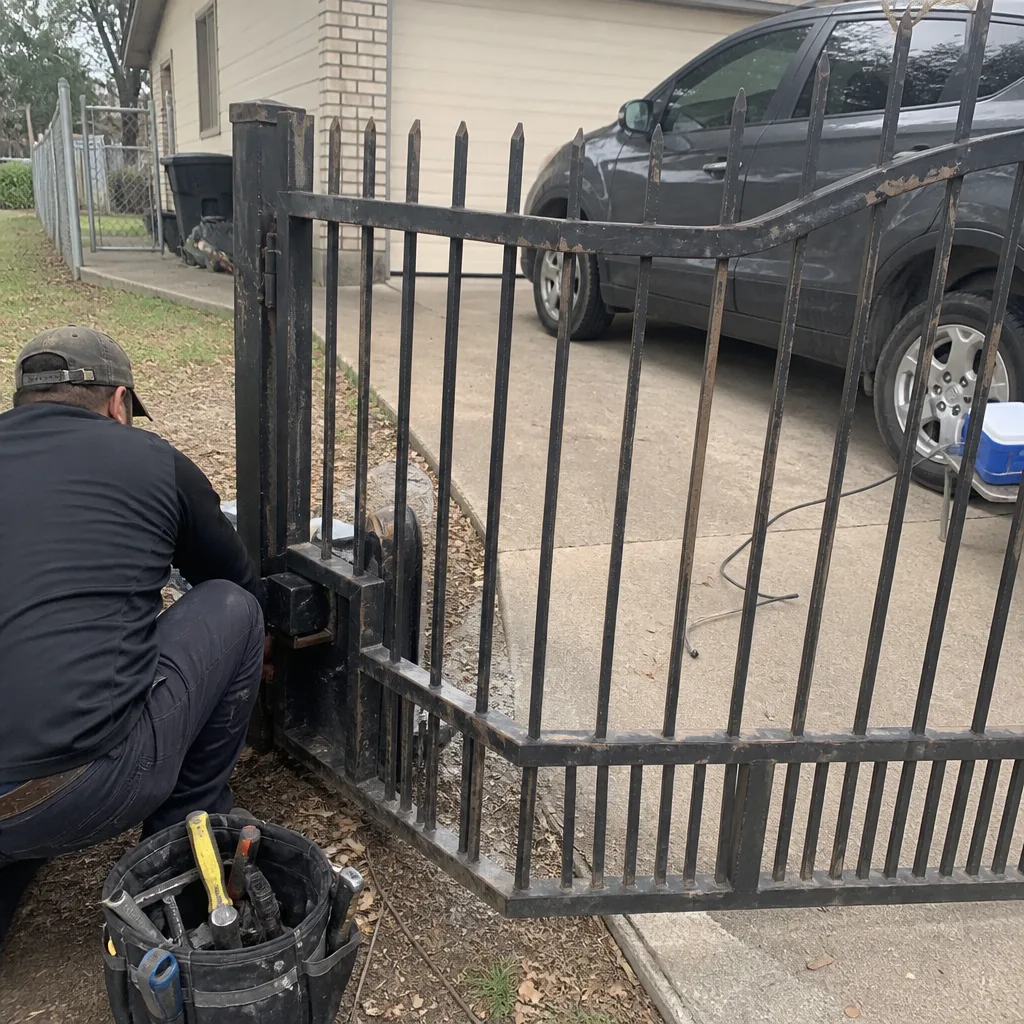
See the difference
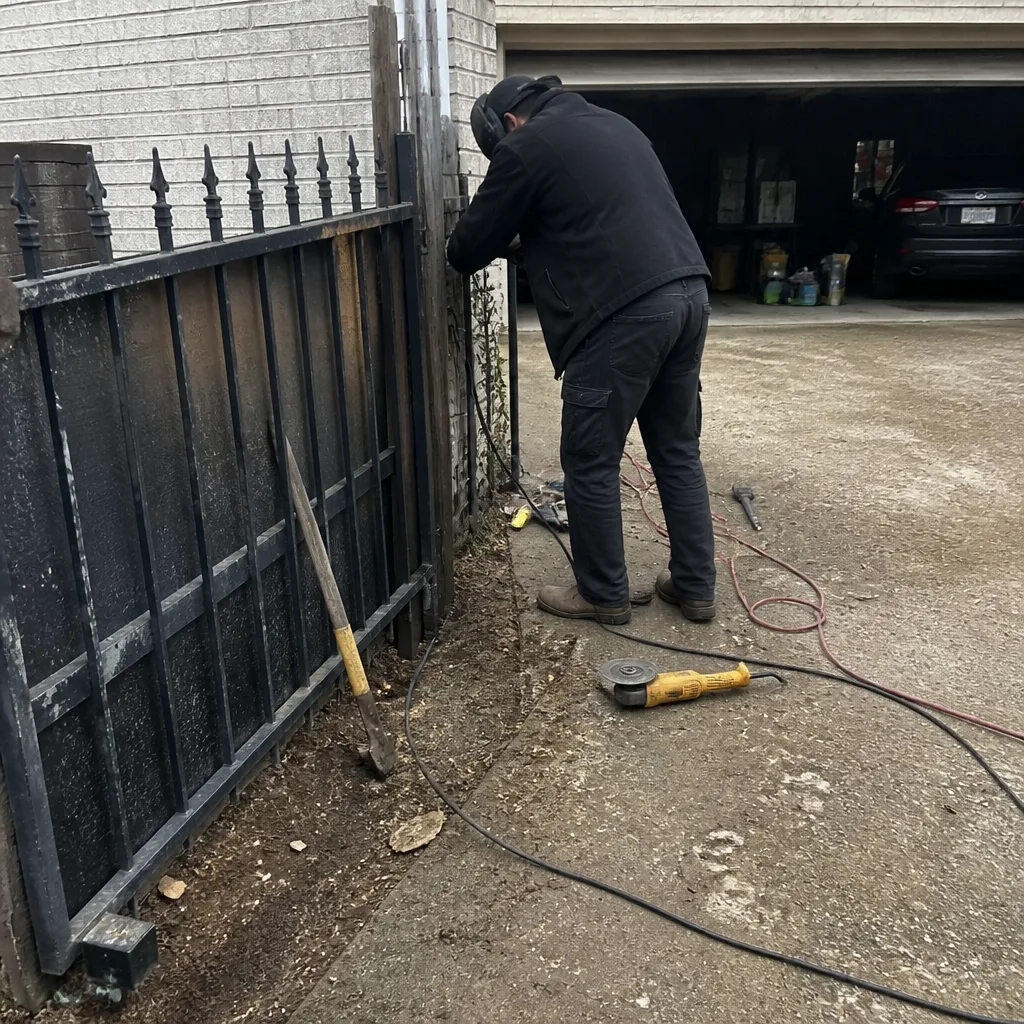 Before
 After
 Before
 After
 Before
 After
When to Call a Professional
Call a professional the moment you hear metal-on-metal grinding, smell anything electrical, or can’t get the gate to complete a full cycle. These are active failures that compound with every attempted operation. Also call if you’ve identified post lean, even if the gate still works. Structural issues don’t self-correct, and the longer the post moves, the more expensive the fix becomes. A professional diagnosis costs far less than a failed operator. Bastion Gate Repair offers free estimates in DeSoto, call (866) 321-6117 and we’ll put eyes on your gate before it fails completely.
Frequently Asked Questions
Most gate repairs in DeSoto run between $200 and $500 for component replacement: limit switches, capacitors, safety edges, photocells, and pulleys. Control board replacements typically cost $250 – $500 installed. Motor replacements and structural work like post re-setting run $700 and up depending on the scope. These are ranges for parts and labor based on the residential systems we service. Call (866) 321-6117 for an exact quote on your specific gate, estimates are free.
We prioritize emergency repairs for gates that won’t close or won’t open because these are security and access failures. The exact availability depends on our schedule on the day you call. Call (866) 321-6117 and we’ll tell you realistically when we can be there.
A full installation includes removing the old gate and operator if present, setting new posts or reusing structurally sound existing ones, mounting the new gate, installing the operator, running or verifying the power supply, mounting and wiring photocells and safety edges, and programming all remotes and access devices. See our Gate Installation in DeSoto page for details on the process and what to expect on install day.
We service nine major brands including LiftMaster, FAAC, BFT, Linear, Viking, Ghost Controls, DoorKing, Elite, and Mighty Mule. If you’re unsure whether we cover your specific model, call (866) 321-6117 and we’ll confirm before scheduling anything.
A slow gate is a gate under mechanical or electrical strain. Waiting lets the failing component damage the components around it. The repair is cheaper today than it will be in three months. If you’re in DeSoto and want a second opinion, call us for a free estimate, and we’ll tell you what the real urgency level is. You can also explore more guides & resources on gate maintenance.
We work on both residential and commercial gate systems across repair, electric repair, and installation. That includes high-cycle operators on commercial properties and gated communities, not just single-home driveway gates. See our Gate Repair in DeSoto page for scope details.
The Bottom Line
Gates don’t fail suddenly. They fail gradually, with specific sounds and behaviors that tell you which component is dying and how long you have. The DeSoto homeowner who recognizes grinding versus squealing, knows what clay soil does to posts, and understands why a slow gate is a warning sign will spend hundreds on repairs instead of thousands on replacements. This guide is a Bastion Gate Repair home reference, a companion to our Electric Gate Repair in DeSoto service page. If your gate is telling you something, listen. The message is cheaper this week than next month.
Written by the team at Bastion Gate Repair, serving DeSoto since 2012.